Dutch Criminal Record: Coastal Home Towns and Indie Surf Rock
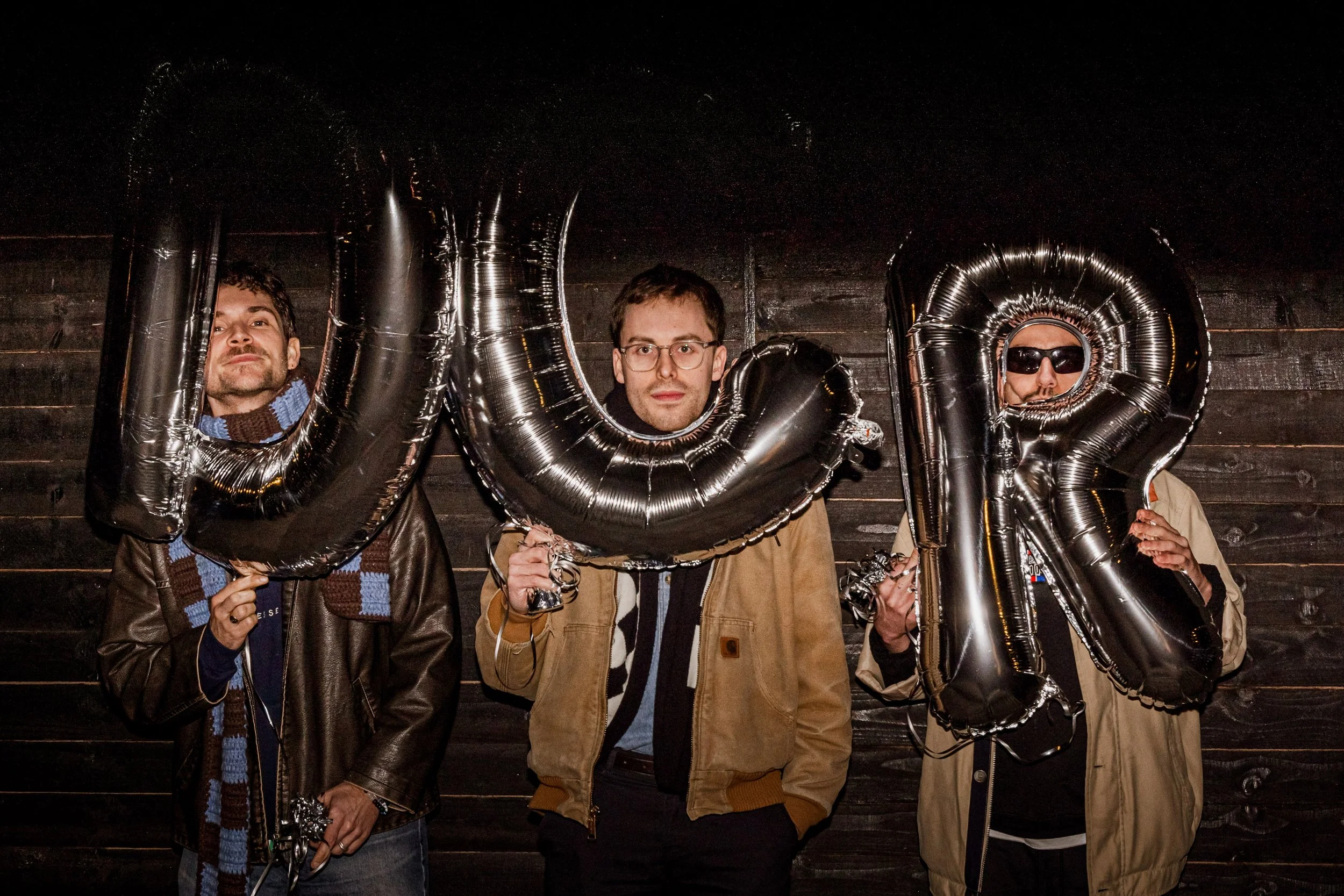
By Allegra CuomoHailing from the south coast of the UK, Dutch Criminal Record are a band who lead with guitars and an energy that instantly springs nostalgia on its listener. Taking early influence from British indie rock staples of the 2000s, combined with American surf rock, their music depicts the narrative of living in 21st century Britain with 'blooming harmonies and dreamy instrumentation'.
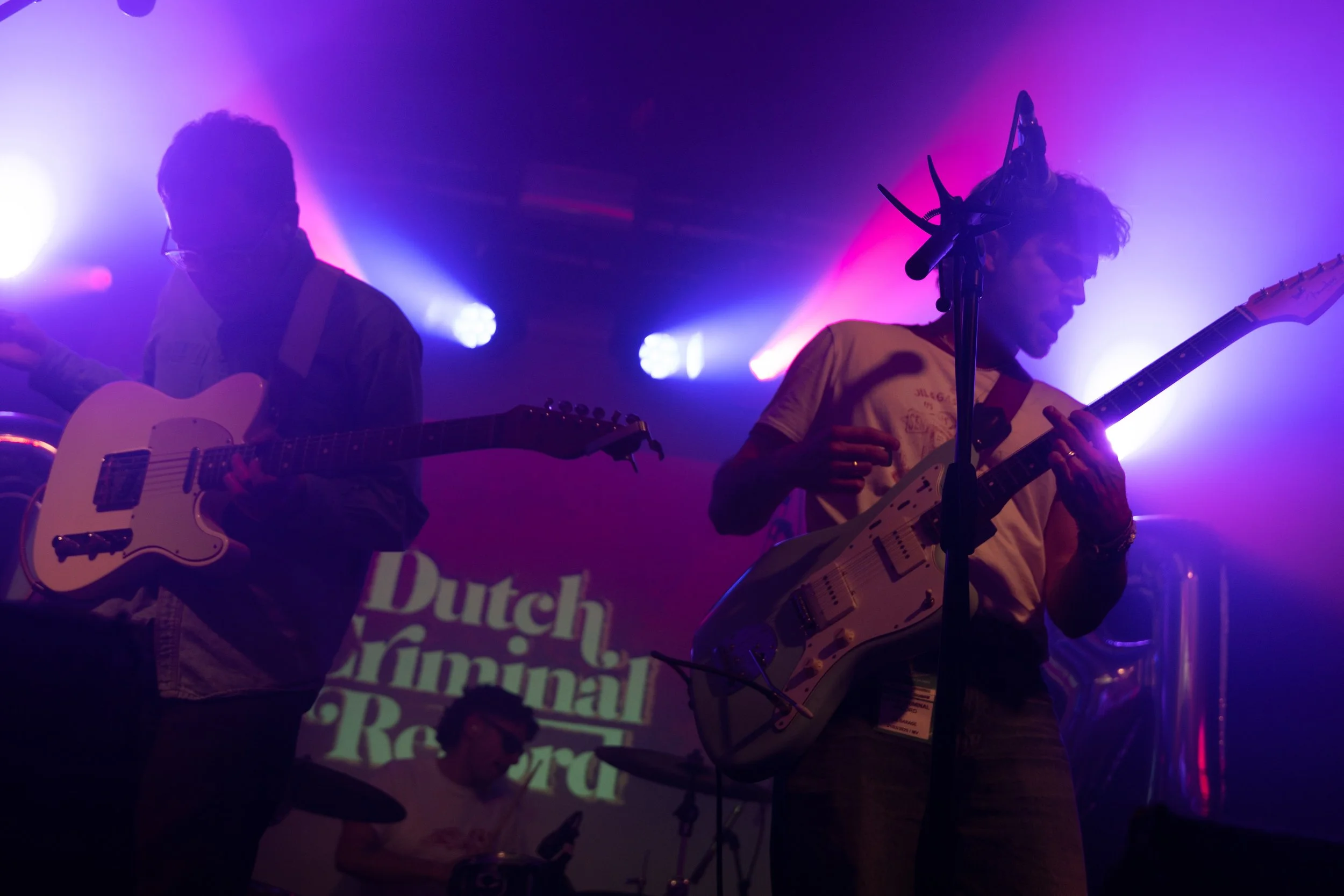
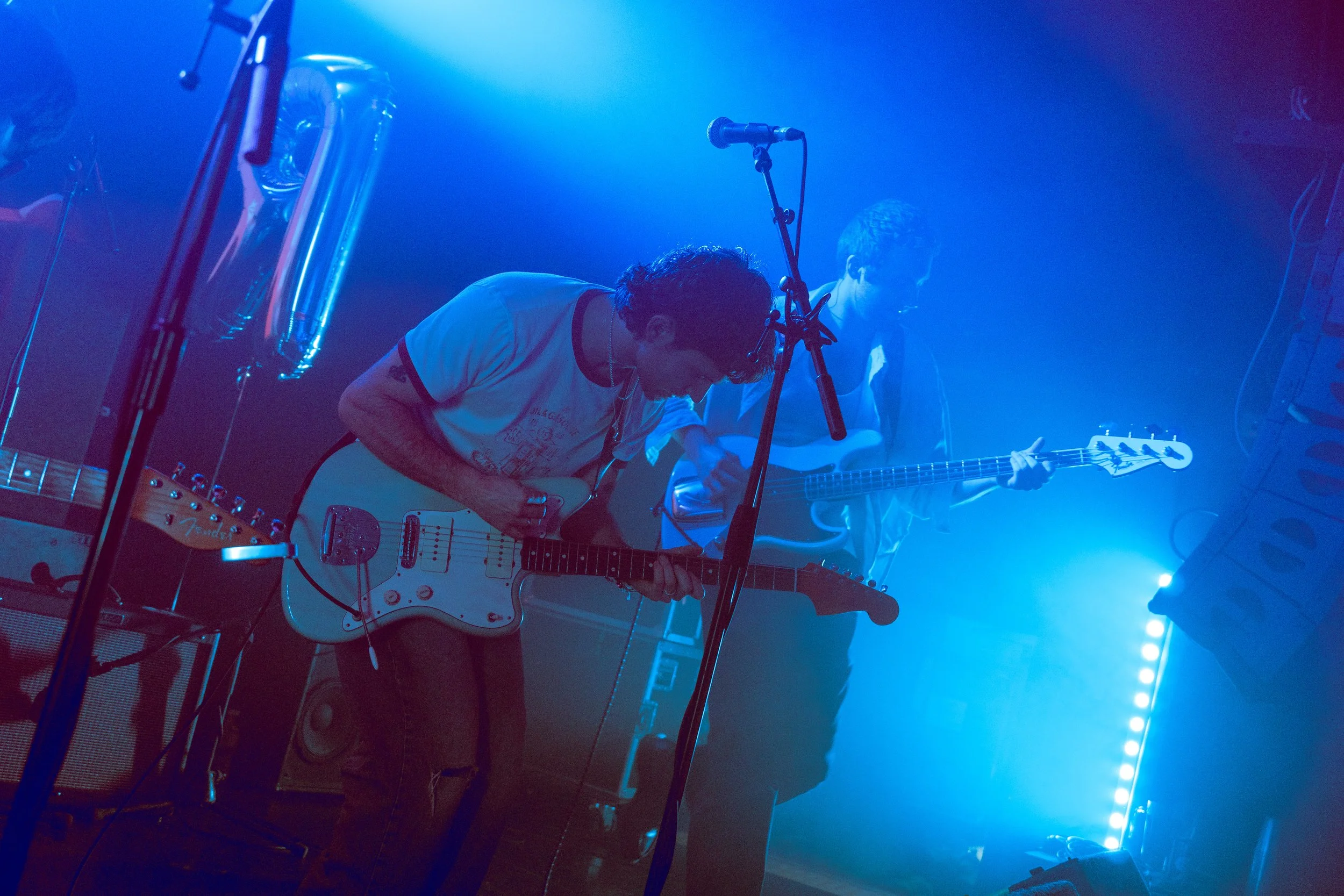
Their debut album, 'Novium' (2024), is full of vibrancy and the lightness of memories of sun and days by the beach, blending their indie surf sound with a psychedelic, modern twist. Rare FM had the chance to speak to the DCR boys on the night they performed in London at The Garage, Hackney on the Novium tour.
MARCH 1st 2025 - THE GARAGE, LONDON
RARE: Allegra Cuomo
Dutch Criminal Record:
Joe Delaney-Stone: vocals / guitar
Sam Thrussell: vocals / guitar
Joe Frampton: drums
RARE: To begin with, could you introduce yourselves and the role you play in the band?
Joe F: I am Joe, (or most people call me Frampton because of the two Joes in the band), and I'm the drummer of Dutch Criminal Record.
Sam: I'm Sam, and I play guitar and I sing.
Joe D-S: I'm Joe and I also play guitar and I also sing.
RARE: Great, lovely to meet you all. Could you give us a bit of information about the origin of the name of the band, Dutch Criminal Record?
Joe D-S: Well, Joe Frampton was in Amsterdam once - kind of a boys trip - and, have you been to the sex museum in Amsterdam? It's quite interesting and actually quite cool! So they went there and the museum had a golden butt-plug, and it wasn't very well guarded so he well-
Joe F: [Laughs] That is not true!
RARE: No way!
Joe D-S: [Laughs] Go on then, tell the true story.
Joe F: So the actual story is of the original drum-mer. He nicked a few beers while on a football tour in Holland and just got a slap on the wrist, nothing more. But came back to school and wanted to be the bad boy, and the story will change every single time about a dutch criminal record.
Joe D-S: This is why we tell a bullsh*t story every single time.
Joe F: We usually make it up, l usually say that Sam got in a fight.
Sam: Yeah normally it's me.
Joe D-S: That's why I wanted to get him, especially because in the last interview he said 'Sam got in a fight with a mime, and pushed him into the canal'.
Sam: He accused me of assaulting a mime.
Joe F: But that is no where near as bad as stealing a golden butt-plug in a museum. But anyway, that's the actual story.
RARE: | did think it was quite suspicious that you were telling a story about one of the other band members and his travels in Amsterdam, wondering where this was going...
Sam: And most people think it's suspicious when he starts making up crap about a mime.
Joe F: Imagine if that museum actually had a missing gold leaf item.
Joe D-S: Either way, this is where the dutch criminal record comes from.
Joe F: Yes, but if they had heard this and where thinking 'hang on' but it was a fake story...
RARE: And criminal records aside, what was the process of forming the band? How did you guys all meet and start making music together?
Joe F: Well, it's a long tale...
RARE: A truthful one?
Joe F: Yes, you can have the truth this time. Basi-cally, me and Sam were in the same GCSE music class and our school did this thing called Charity Week where every day there would be some event on for charity, and one of these events was Battle of the Bands. There were two Battle of the Bands days, one was on Wednesday and then the final on Friday, and so we formed for the Battle of the Bands. We were both in music with a few of our friends, made a band, and we covered 'Moving to New York' by The Wombats. It was a really bad cover because we had no time to practice.
At the time we were called Admission, we weren't called Dutch Criminal Record, because we didn't have a name and when we went to sign up to Battle of the Bands we needed to pick a name and there was an admission form. Then our old drummer, started saying the stuff about Dutch Criminal Record, and we joked that that would be really good name for a band, but we'll change it after Battle of the Bands because it was kind of corny, and then 10 years later we still have the name.
RARE: Fair enough.
Sam: Yeah so we formed and we just kinda carried on really.
Joe F: And then Alex, our former drummer, left in 2017 and Joe joined then. After that we started taking it a bit more seriously, and here we are.
RARE: Here we are indeed. You mentioned the first song you covered, so we were wondering what were some other musical inspirations when you guys first started making music, and how have those changed since?
Sam: Our second Battle of the Bands, because we didn't make the final of the first one, we auditioned with 'A-Punk' by Vampire Weekend. We then played 'What You Know' by Two Door Cinema Club and 'Fluorescent Adolescent' by Arctic Monkeys. Around that time we were really into Fouls, Maccabees, Bombay Bicycle Club, and the surf rock beachy stuff was a combination of The Beach Boys, thinking ‘we live by the sea too’, and also bands like Real Estate, and other ones like Beach Fossils. We kinda tried to meld British indie rock with American surf rock.
RARE: Awesome. In terms of recording and making music, how do you guys approach song writing versus production? Do each of you have an individual role or is it a more collaborative effort?
Joe F: Depends on the song, but generally it's quite collaborative. Say I've written a song, sometimes it will have all the guitar parts fleshed out, sometimes it wont, and we get a demo together to give us an idea of the structure and then we will play around with it in band practice.
Then, once we've had at least one practice (hopefully), we then go into the studio and that is the point where the structure of the song is de-cided, the verse, the chorus, and then everything else is up for debate - when does that part come in, should we put that part there. Most of the time, with 'Novium' for instance, we knew a lot of what we were doing before we went in the studio.
It didn't used to be like that, we used to always practice loads and loads and move things around. Recently, we went into the studio and did a track where we hadn't really sorted out what we were doing with it other than the basic idea, and that was really nice because it felt like the old way that we used to do things. It's not very economical doing that because you waste loads of your studio time, but I think it was good for the song and it feels nice to work on something together and think about what it could be. Just depends on the song really.
Sam: Yeah, I would say me or Joe usually start the songs but Frampton often has a unique position because he will sift through what works and say "this one's good but it needs a bridge" or something. So we all have a unique position, me and Joe usually start it but Frampton more giving a bird’s eye view of the track.
Joe F: Joe's more like the arbiter of what we are writing I suppose, it's hard to start a song on drums.
[They all laugh.]
Sam: 'Baby Blue'.
Joe F: Actually, 'Baby Blue' is a good example because I had made the instrumental for it but l didn't particularly like it, wasn't that fussed by it and then one time I invited these guys round to my flat to make content or something.
Sam: TikToks
Joe F: I think so, and I had an absolute savage hangover and I think instead of making content Joe and Sam were just flicking through the instrumental demos on my computer, and they found one called 'Baby Blue' and said "that's good, you should make something out of it" and I wasn't planning on making anything out of it.
RARE: And are there some songs were the demo and the final song have very little change between them?
Joe D-S: Sometimes, though I would say there are always micro-changes.
Joe F: I would say that's probably true, and depends on the song really. There are some songs where essentially all we've done are Sam's acoustic demo and then we basically turn that into an electric song. It hasn't necessarily changed that much, except the instrumentation being slightly different, and the core of the song is still there.
However, I think more often than not, especially with our producer Rob who's fantastic, we give him licence that if he wants to add something, we just let him do that because we know he's so tasteful and he would never put anything in that doesn't fit, and if he does he never sends it to us. I don't think we've ever had something Rob has added and thought that it should be taken out. He only adds these little bits that you might not hear the first time you listen, but will pick up on a later listen. So certainly things change in the studio.
RARE: Building on that question, how has your process of making music changed throughout the years?
Joe F: When we started, our first two EPs were just rehearsed in a band room. Now we will do a crash recording of it and we will have a demo. What this does is giving you a trial run to try different things, such as this sample or this depressor or a particular production style or weird thing on a chorus. 'Baby Blue' is a good example because I would have never done that without having pre-recorded it. So there is a sample at the end of 'Baby Blue' which is from Alan Watt's 'Divine Meditations' from the 1960s and in the song's ending the sample plays over the instrumental. We would never have thought of that because also the sample is chopped up into specific sections so it kind of times up with the music but also kind of doesn't - never would have thought of that in a band room when you're practicing. That's how recording a song before has had quite a big change to trying new things.
Sam: With some of the early stuff like 'Corona' off the 'Mirage' EP - bit of a deep cut - that was written in the band room instrumentally, this being in 2015. Then we all had a cup of tea downstairs and shouted out different vocal lines, meaning the vocal ended up being cut together from our different lines and that was so collaborative. Our stuff now is still collaborative but in a different way; collaborative in the later stage instead of at the start.
Joe F: Apart from the track we've just done. I'm really excited, I still have no idea how it'll turn out.
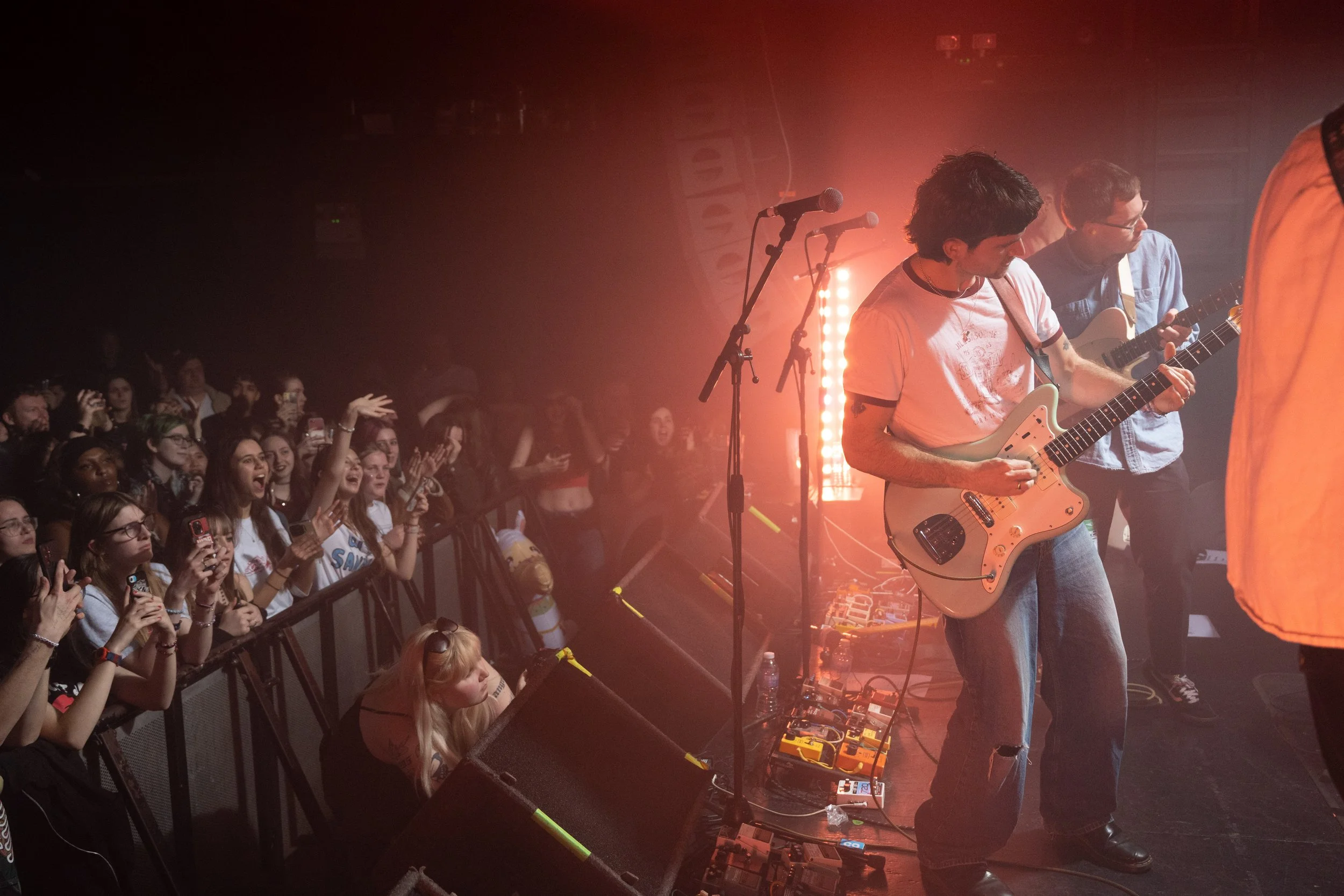
RARE: Now a bit about performing live - do you have a favourite aspect about performing live or a particularly fond memory from performing live?
Joe F: Personally, my favourite aspect that runs through most of our shows is the final hit of the last song. This is when you know there's been no major f*ck ups, assuming there were not major mess ups, and if it went really poorly then I don't count that show.
Sam: For me, the funnest shows are when they surprise you. When a show is much better than you thought it would be or when you break new ground. For example, playing a venue that is much bigger than you are, or when you capture that thing that got you into music in the first place, forgetting there is an audience out there and you are just playing a song with your band.
We are playing a song called 'Painted Gold' on this tour that is a really old one, and I like that because it reminds me about why I got into the band in the first place. Because at times you can lose that, you start thinking about ticket sales or if anyone is going to come, or are we going to sell any merch; but then, the best moment for me, is that.
Joe D-S: Every now and then an old song catches you. Or trying a new song for the first time, that's pretty cool. I remember trying 'Baby Blue' for the first time with the sample, and thinking "that's cool, we've never done anything like this live”. And I remember 'It's going to be ok' being quite cool for the first time live, because we had never done a spoken word track before. It's a weird one because playing live is fun but you're constantly monitoring "is my gear ok, is everyone ready for the next song, what am I going to say next to the crowd?" While it's fun, it is simultaneously stressful. Maybe we only enjoy it in hindsight...
Joe F: On our first tour in 2022, this was a standout moment for me: we had never toured before and we had just had a lot of clout on TikTok and blown up a bit. It was in Bristol where the crowd were singing back 'Living in Dreams' well as 'Stuck Between and 'Socks', but we had never had that at our shows before. These weren't mates, they were fans who had come and knew all the words and were singing it louder than Sam was. That was cool.
RARE: When emailing to arrange this interview, I mentioned to Tom that I saw you guys last week opening for The Wombats at Chalk in Brighton.
DCR: [They all laugh] No way!
RARE: Seeing you guys live was great and I actually reached out while on the train on my way home when I found out you guys would be performing in London this week.
Joe D-S: That show was fun for us, because as we said Wombats were one of those first bands we covered and were my heroes when we first started writing music. It was weird meeting them backstage afterwards, getting a photo with them. We've supported bands before and usually you have a great rapport with them, unless they're your heroes from when you were young. I walked into their dressing room to ask for a photo and Mitch and I were hovering by the door awkwardly.
RARE: For my last question, I was wondering if you could tell us a bit about some upcoming music and has your approach to this future changed since producing 'Novium'.
Joe F: We've only really been in the studio twice since 'Novium'. One was to record an older track that we've wanted to get laid down for a long time. The other was to try a new track. I really would like that for most of these new tracks, that we can try a different approach. Not because I think the way we approached 'Novium' was bad, but because it's nice to keep it fresh. I think if we're not restless creatively, then we are not going to make something interesting. We could make 'Novium' part 2 if we wanted to, but I don't think that's a good idea. So, I hope it's going to be different and that the output will also be different.
RARE: Keeping the process exciting, changing things.
Joe F: Yeah, exactly. That said though, one of the two songs we have recorded is one of our oldest songs ever.
Sam: From 2013. Even that song in of itself was a bit of an anomaly. Joe and I play a few different instruments on it. Back then we were always trying different things. I have so many ideas I would want to do, both from a songwriting perspective but also from a production point of view. We could go on a writing retreat in the Yorkshire Dales.
Joe D-S: Could it be a nice villa in Barcelona please.
Sam: Could be, could be. What I'm saying is that it's always good to try new things, and like Joe was saying earlier, this new track. We were working bits out in the studio, that was new for us. There's always new aspects, some are micro, some are macro.
RARE: Great, thanks for answering all my questions. We are looking forward to hearing what you have next in store for us!
Check out Dutch Criminal Record's debut album 'Novium' (2024) and their 2025 cover of Chappell Roan's 'Good Luck, Babe'.